The six Clivia species
Daniel Pretorius · 6 min read · 1 September 2026
Every plant in this catalogue traces back to one of six wild species, and all six are southern African. Clivia belongs to the amaryllis family and was named by John Lindley in 1828 in honour of Lady Charlotte Florentine Clive, Duchess of Northumberland. Five of the six species come from the summer-rainfall forests and slopes of the eastern seaboard: the Eastern Cape, KwaZulu-Natal, Mpumalanga, Limpopo and Eswatini. The sixth grows alone in the winter-rainfall Northern Cape, a province away from its nearest relative. Knowing the six is not academic. Habit, flower form and flowering season all run back to them, and so does most of the vocabulary the rest of the Journal leans on.
A species, a cultivar, a colour class
Three words do different work, and growers mix them at their cost. A species is a wild thing: a naturally occurring population, described and named botanically. Clivia has six accepted species, and every one of them grows wild in southern Africa. A cultivar is a chosen thing: a named selection kept in cultivation for a trait worth keeping, and held true by division, because an offset grows into a clone of its parent. The Clivia Society maintains a register of such names. A colour class is neither: it is show vocabulary, a description of one flower against a chart, from red through the oranges, yellows, pinks and peaches to green and bronze. A colour class says what a flower looks like on the day. It says nothing about parentage.
One more word matters. A cross between two different species is an interspecific hybrid, and once a plant is interspecific it stays interspecific, however it is crossed again. The Society judges these by flower shape, from the open bell through conical and trumpet to the closed tubular form.
Two flower architectures split the genus cleanly. One species holds its flowers upright, open and trumpet-shaped, facing the viewer. The other five hang theirs: pendulous, narrow, tubular florets that point at the ground. That single distinction organises almost everything below.
Clivia miniata: the bush lily
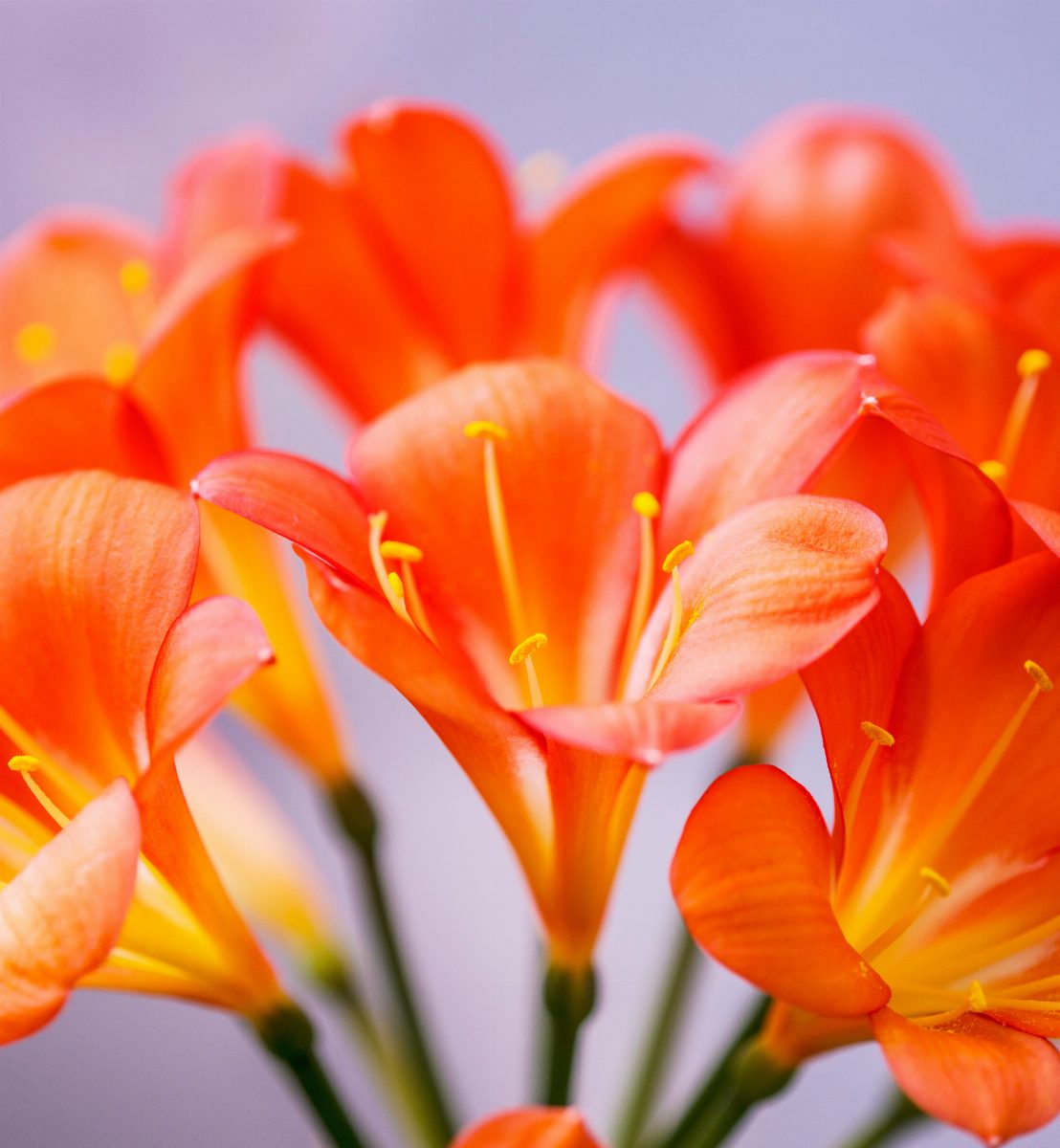
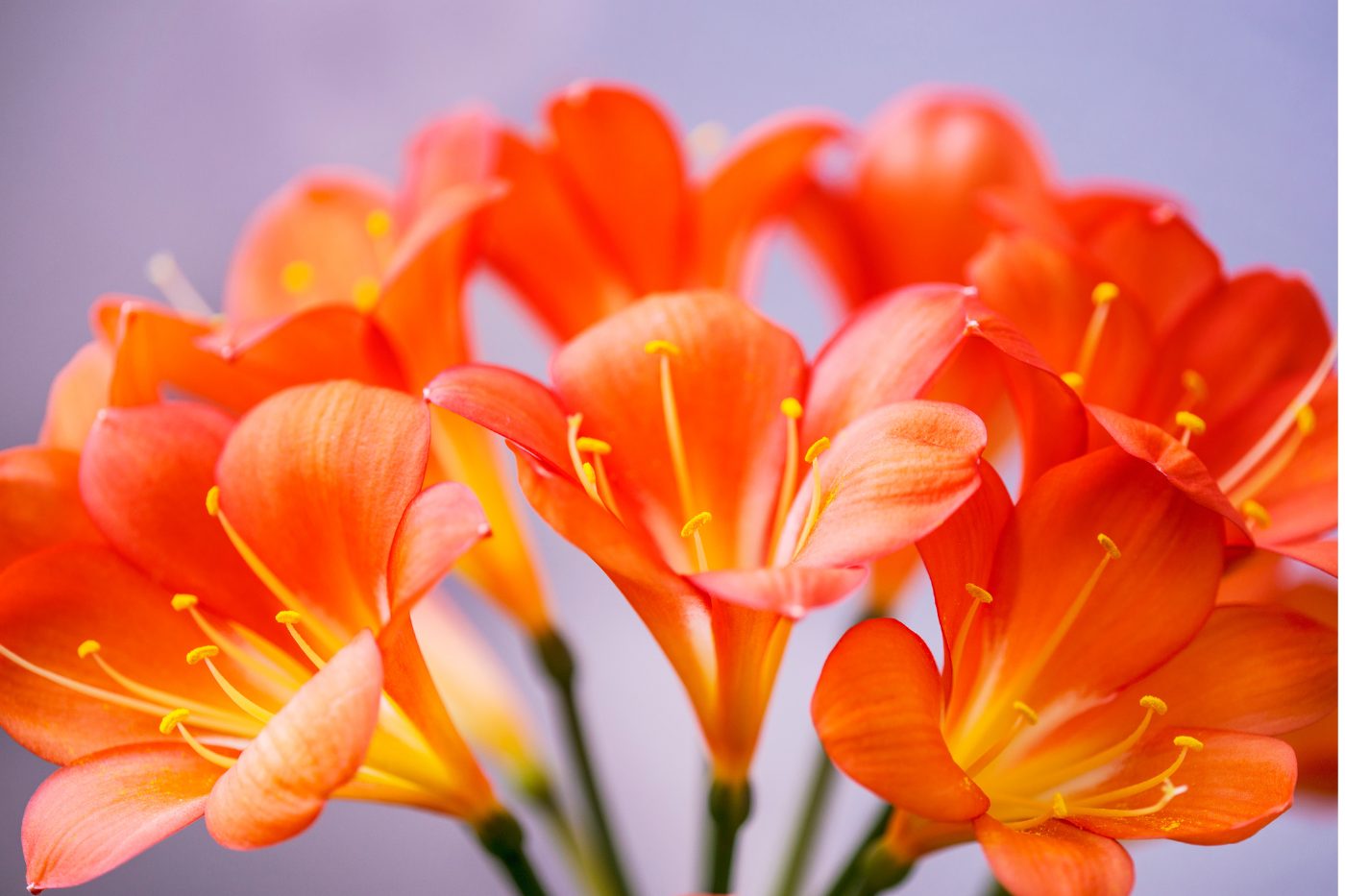
The species most people picture when they hear the name. C. miniata grows on the forest floor of the Eastern Cape, KwaZulu-Natal and Mpumalanga, and into Eswatini, in humus-rich, well-drained soil under a closed evergreen canopy. It makes an upright clump of roughly 400 to 600 mm, and it is the only species with erect, open, trumpet-shaped flowers, held ten to twenty or more to the head, facing up and outward. In the wild it is brilliant orange with a yellow throat; a rare natural yellow, long known as var. citrina, occurs. In cultivation its colours have been bred out to red, apricot, peach, pink, cream, yellow, green-throated, bronze and bicolours. It flowers mainly in spring, August to November, with the odd head at other times. For the grower it is the foundation: the upright form and the colour range make it the backbone of colour breeding and of most named cultivars.
Clivia gardenii: colour in the cold months
Named by Hooker in 1856 after Major Robert Garden, who collected it in Natal in 1855. C. gardenii comes from the coastal and mist-belt forests of KwaZulu-Natal, with records into Mpumalanga and Eswatini. It grows as an evergreen tuft of 600 to 1300 mm with narrower, darker leaves than miniata, and carries pendulous, curved, tubular florets in orange-red through yellow, tipped green. What earns it a place on any bench is the calendar: it flowers in autumn and winter, roughly May to July, when the spring species are silent. That is why it is a key parent for extending the flowering season. Its berries are unhurried, ripening some twelve to fifteen months after pollination.
Clivia caulescens: the one that builds a stem
Described by R.A. Dyer in 1943, C. caulescens grows in the mountain forests of Mpumalanga and Limpopo, from Kaapsehoop north to Tzaneen and Barberton west to Mokopane, and into Eswatini, often on moss-covered rocks and cliffs. It is the only clearly stem-forming species: a leaf-bearing aerial stem that can pass 1 m and occasionally reach 3 m, which makes a mature plant genuinely architectural. The flowers are pendulous and tubular, orange to orange-red with green tips, in spring and summer. For the grower it offers height and drama that no other species can, and for the breeder a stem habit that can be carried into hybrids.
Clivia nobilis: the first, and the slowest
The species that started it all: C. nobilis was the first Clivia described, by Lindley in 1828. It grows along the Eastern Cape coast in isolated populations, from the Alexandria Forest near Gqeberha north to Hole-in-the-Wall, with inland plants in the Zuurberg up to about 600 m. It is slow-growing and forms dense clumps of arching, strap-like leaves. The heads are generous: forty to sixty narrow, tubular, hanging florets, pale to dark orange or orange-red with distinct green tips, and an unusual pale pinkish-yellow variant occurs. It flowers between late autumn and spring. It asks for patience above all: at least six years from seed to first flower, though an offset or division will flower in about two. The refined pendulous form and those green tips carry real breeding weight, and the historic hybrid Clivia x cyrtanthiflora, a miniata by nobilis cross, descends from it.
Clivia mirabilis: the outlier in the west
The most recently discovered species, described by Rourke in 2002 from the Oorlogskloof Nature Reserve near Nieuwoudtville in the Northern Cape, where it grows in humus-rich sandstone rock crevices. Everything about it is the exception. It is the only species from the arid, winter-rainfall west, far from the eastern range of the others, with firm, leathery leaves of 800 to 1200 mm, often reddish at the base, and a semi-dormant, drought-adapted growth cycle. The florets are pendulous, tubular and bicoloured, paler toward the tips, twenty to forty-eight to a head, in spring, September to November; its berries ripen fastest of all the species, by about March. For the grower the lesson is to keep it on its own calendar rather than the eastern one. Its drought tolerance and reddish leaf base are prized novel traits, and it remains rare and highly collectible.
Clivia robusta: the giant of the swamps
Formally described only in 2004, by Murray and co-authors, C. robusta is endemic to the Pondoland region of southern KwaZulu-Natal and the far northern Eastern Cape, where it grows in damp and swampy evergreen forest. It resembles gardenii but is bigger in every respect: the largest species, at roughly 1200 to 1800 mm, with broad strap leaves. The flowers are pendulous and tubular, orange-red with green tips, and its forms run from soft pink to deep red, with occasional yellow, peach and apricot. Like gardenii it flowers in autumn and winter, roughly May to July. Its distinction on the bench is tolerance: it is unusually forgiving of wet soils compared with every other species, which, together with its size, makes it interesting for larger, hardier hybrids.
What the six mean on the bench
Set the seasons side by side and the genus covers most of the year. miniata and mirabilis flower in spring, caulescens runs spring into summer, gardenii and robusta carry autumn and winter, and nobilis spans late autumn to spring. A collection built with all six in mind is seldom out of flower for long.
The trade, though, leans one way. miniata is the icon of the genus, and its upright trumpet and wide colour palette made it the foundation of the ornamental trade and of most named cultivars. Our own register tells the same story in miniature: of the plants recorded to species, more than half are miniata, with gardenii the strongest of the pendulous five. But the pendulous species are not the supporting cast. They are where the season stretches, where the green tips come from, and where the collector's end of this catalogue lives. In this collection we grow both, because the six species are not six versions of one plant. They are six answers to six different places, and the breeding that fills these benches is the conversation between them.