How Clivia genetics work: dominant and recessive traits
Daniel Pretorius · 5 min read · 27 August 2026
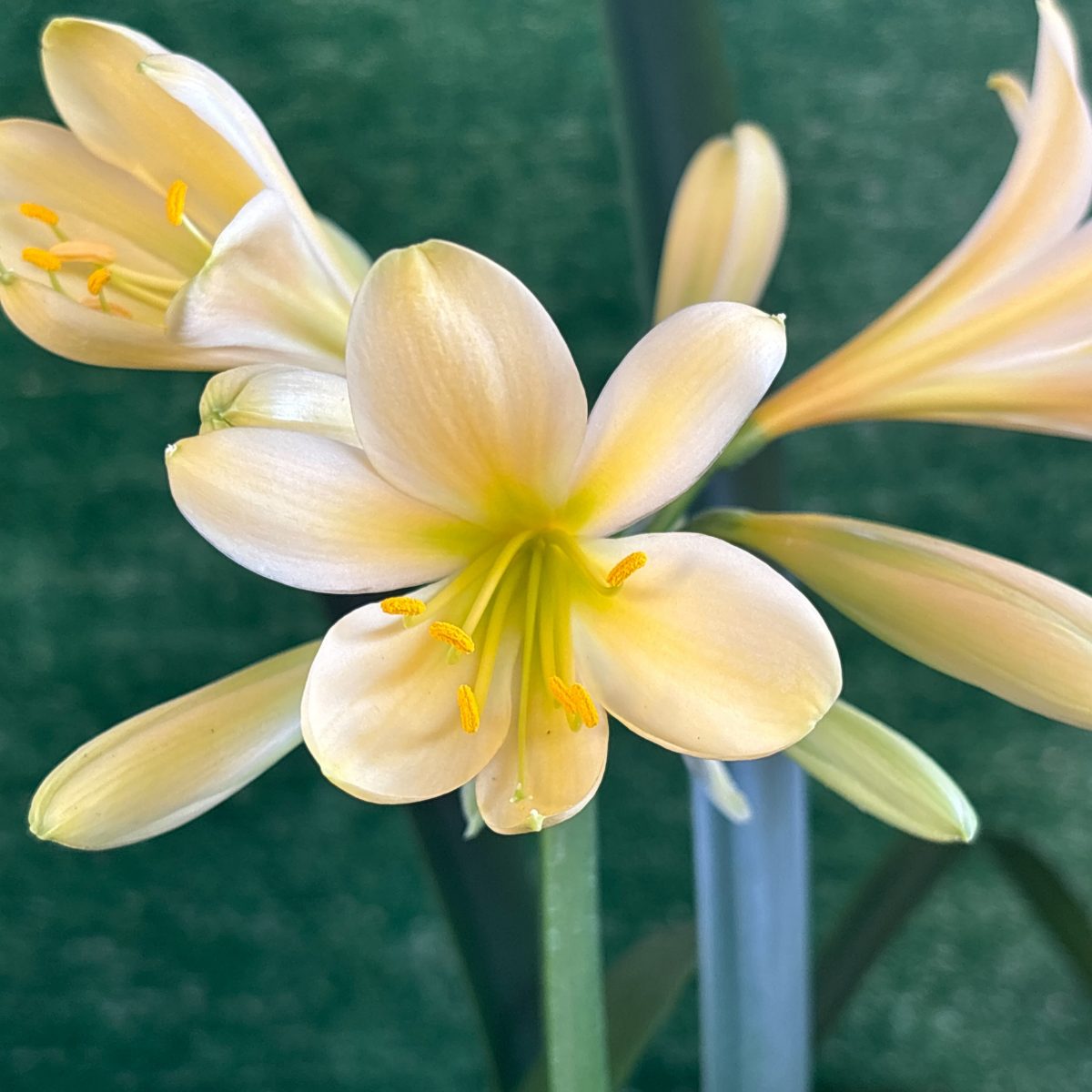
Every Clivia a breeder sells is the outcome of a cross, and the trait most people notice first is colour. A little genetics helps a grower read a plant's parents in its flowers, and explains why two plants of the same colour can throw seedlings that look nothing like either of them. The colour names used below follow the Clivia Society standards, the same show vocabulary the catalogue uses: red, the oranges (dark, mid and light), the yellows (dark, mid and light), pink, apricot, salmon, the peaches, green and bronze.
Dominant and recessive, in plain terms
A plant carries two copies of most genes, one from each parent. A dominant trait shows even when only one copy is present. A recessive trait shows only when both copies agree. This matters because a plant can carry a recessive trait without showing it: an orange flower can quietly hold a yellow copy and pass it on. That hidden copy only surfaces when it meets a matching copy from the other parent.
Why orange is dominant and yellow recessive
The colour of a Clivia flower comes from two kinds of pigment. Carotenoids give the yellow to orange background, and anthocyanins add the red on top. A normal orange flower has both. A yellow flower is one where the red anthocyanin is switched off, so only the yellow carotenoid remains, usually with the green throat the standards record separately.
Making the red pigment is an active process, and a single working copy of the gene is enough to run it. So a plant with one make-red copy and one no-red copy still comes out orange: orange is dominant. A flower is yellow only when both copies fail, which is why yellow is recessive and, in the wild, far rarer than orange. The rare natural yellow miniata, long known as var. citrina, is exactly this: a plant that lost its red.
The two yellow groups, and why two yellows can give orange
Here is the part that surprises new breeders. Cross two yellow Clivias and the seedlings are sometimes all orange. That is not a mislabelled pollen parent. It happens because there is more than one way to switch off the red.
Think of the red pigment as needing two switches that both have to be on. Some yellows, called Group 1, have the first switch off. Other yellows, called Group 2, have the second switch off. Each is yellow for its own reason, and each still carries a good copy of the switch the other one lacks. Cross a Group 1 yellow with a Group 2 yellow and the seedling inherits a working first switch from the Group 2 parent and a working second switch from the Group 1 parent. Both switches are now on, the red returns, and the flower is orange.
This is why breeders track which group a yellow belongs to. Two yellows from the same group breed true to yellow; two from different groups can throw orange. The exact number of genes involved is not fully settled, but this two-group behaviour is well documented by Clivia growers and reliable enough to plan a cross around.
What a cross tends to throw
A few rules of thumb follow. An orange that secretly carries a yellow copy, crossed with another such orange, gives roughly three orange seedlings to every yellow one. A pure orange carrying no yellow copy, crossed with a yellow, gives all orange seedlings that each now hide a yellow copy, ready to surface in the next generation. These are tendencies across many seedlings, not promises for a single berry, and the pinks, apricots, peaches and bronzes involve further genes that make their inheritance richer still.
Variegation is inherited differently, and less predictably
Leaf variegation does not follow the neat parent-to-seed pattern that colour does. Per the Clivia Society standards it is split by the direction of the pattern into longitudinal types (the marginal Fukurin, the striped Shima-fu, the median Naka-fu, the half-and-half Genpei-fu) and non-longitudinal types (Light of Buddha, the transverse Akebono, and Tiger). Most are chimeral: the pattern lives in particular layers of cells in the growing plant, not in the seed. Because of that, chimeral variegation usually does not come true from seed, and the reliable way to increase a good variegate is vegetatively, by offsets or division.
Where variegation does pass through seed it often travels through the mother plant rather than the father, in the way leaf-colour traits are commonly inherited down the maternal line. Some patterns are more seed-stable than others: Akebono is reported by growers to come through in a high proportion of seedlings, though that is an observation rather than a controlled study. The honest position is that Clivia variegation is only partly understood, it varies from plant to plant, and a plant can strengthen, weaken or revert over time. Each variegate is best judged and photographed on its own.
Why the cross is kept
Because colour hides recessive copies and variegation resists prediction, the record of what was crossed is worth as much as the plant itself. Knowing a plant's mother and father, and what they threw, is what lets a breeder aim the next cross rather than guess. That is why every plant here carries its cross.