Back to the Greenhouse Journal
Common Clivia pests and how to beat them
Luka Gouws and Daniel Pretorius · 4 min read ·
Clivia are hardy plants, good at surviving. That being said, Clivia are still susceptible to pests. Snails, slugs, sap-suckers and the amaryllis borer can cause anything from mild inconveniences to dead plants. Here's a list of pests, their level of damage, and the best way to prevent infestations and cure plants.
The classics: snails and slugs
Snails and slugs are the most common pests. They are soft-bodied and legless, and snails carry a coiled shell. They leave a tell-tale shiny slime trail and thrive in damp conditions. At night, they feed on soft tissue, particularly on new leaves in the centre of the fan and emerging flower scapes. One night's feeding on the scape can ruin the flower for the whole season.
The most effective way to combat these pests is to keep the plants clean and in good condition. During the day, snails and slugs hide in damp and darkness, so clear dead leaves and debris around the crown. If the plants are potted, keep them off the ground and on a sieve-like surface. Keep the area on and around the surface clean, and don't water late in the day. To clear pests quickly, remove them one by one at night under torchlight.
Here are two organic methods to keep the snails and slugs away:
- Beer traps: fill a shallow container with beer and sink it into the soil level; this will attract and drown the snails and slugs overnight. The trap must be emptied and refilled every few days.
- Iron-phosphate (ferric phosphate) bait: scatter the bait thinly (per the label), and refresh after heavy rain. Slugs eat the bait, stop feeding and die, and the active ingredient breaks down into safe iron and phosphate, which is safer than older metaldehyde baits.
Sap-sucker: the mealybug
Mealybugs are approximately 3 mm long, oval, light-pink, slow-moving insects covered in white waxy threads, with two longer threads at the tail. They are typically found in the leaf sheaths at the base of the plant. When there is overcrowding, poor airflow and heat, they excrete a sticky honeydew that grows black sooty mould which can carry viruses. A trail of ants can be a giveaway, as they farm and move mealybugs.
To combat a mealybug infestation, ensure that plants have enough space and thin an overcrowded clump. If the infestation is still in its initial stage, simply use a cotton bud or firm jet of water to dislodge the colonies. If the infestation has spread past this point, thoroughly work mineral oil or neem oil into the leaf bases. Repeat the process a week later to catch the next generation.
The most dangerous pest: amaryllis borer
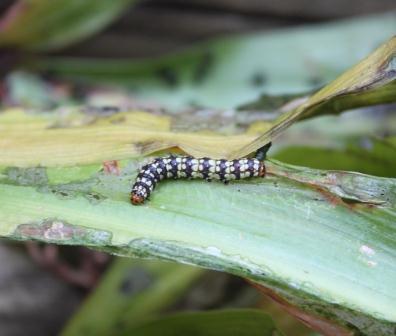
The amaryllis borer (or lily borer) is the most dangerous of the Clivia pests. If it manages to reach the centre of the plant, it can kill the plant. Amaryllis borers hatch from the eggs of a grey-white moth that flies at dusk and lays eggs on the undersides of leaves. The caterpillars are black with yellow bands. They tunnel down inside the leaf toward the centre. The best way to spot an infestation is to look out for a pale, sub-surface tunnel between the upper and lower leaf surfaces.
Borers are more active in the warmer months, so inspect the leaves several times a week from October to April. Always turn the leaves over and rub off the eggs before they hatch, and squash any caterpillar found inside a leaf. For warm months, after flowering season, use a systemic insecticide with imidacloprid as the active ingredient. Confidor, Koinor, PUNTO 35 and Imidor are excellent options. As an added bonus, they are also the best way to control all the pests discussed.
What else can harm Clivia?
Rot also poses a significant threat. Clivia are semi-epiphytic: their roots are adapted to grow in leaf litter with open air. So, when a Clivia is overwatered or in a slow-draining mix, their roots can rot. Root rot and bacterial soft rot (which turns the centre of the plant into foul-smelling mush) can be prevented by letting the Clivia grow in an open, free-draining method (pine bark is the best option). Keep the crown at or just above the surface so that water does not pool in it, and limit watering to once or twice a month in the winter. If there is rot, lift the plant, cut away every trace of rotten tissue with a clean blade, let the wound callus and dry, treat with a fungicide, and repot into fresh, better-draining mix. Always sterilise the knife between plants.
Can a garden be totally pest-free?
Short answer: no. Long answer: Clivia are part of a complex ecosystem, and every living thing in an ecosystem will interact with each other. The best way to keep your Clivia clean and healthy is by having a routine. Use the right mix and placement for drainage, make sure that the Clivia is not exposed to the harsh midday sun, do not overwater the plant, and regularly examine the leaves and base for pests. If you catch the infestation early enough, reach for the least-toxic control and follow the label. Only use the strong chemicals as a last resort.